
Introduction
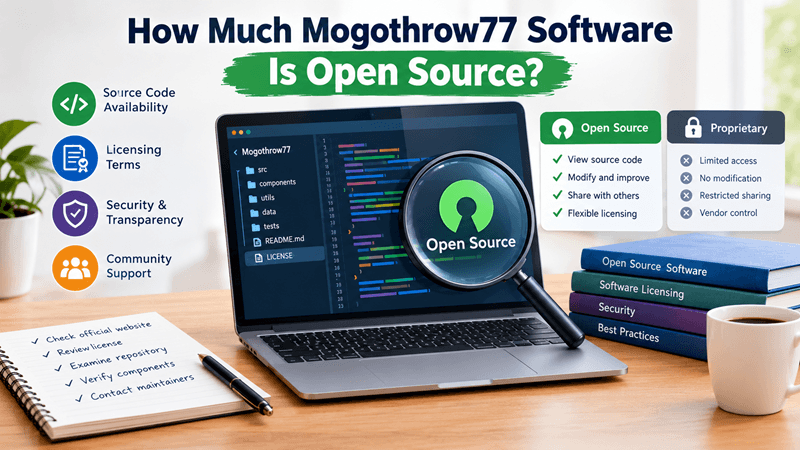
Open-source software has become an important part of modern technology. Developers, businesses, students, and everyday users increasingly want to understand how software works, who controls its source code, and whether they can modify it to meet their needs. These questions are particularly important when choosing tools for business operations, software development, data management, and technical projects. One question that has attracted attention is how much Mogothrow77 software is open source. To answer it properly, we need to examine the meaning of open-source software, the importance of software licensing, and the evidence available about Mogothrow77. The most important point is that publicly available information does not establish a reliable percentage of Mogothrow77’s code as open source. Online articles make conflicting claims about whether the software is completely proprietary, partially open, or fully open source. Without a verifiable source-code repository and applicable license, these claims cannot be treated as confirmed facts. This guide explains how to evaluate Mogothrow77’s open-source status, what developers should investigate, and how users can make informed decisions before adopting unfamiliar software.
1. Understanding Open-Source Software
Open-source software is software whose source code is made available under a license that permits users to perform specified activities, including using, studying, modifying, and redistributing the software. The exact permissions depend on the license. Some licenses impose relatively few conditions, while others require particular notices, attribution, or the distribution of source code when modified versions are shared.
For example, the MIT License generally permits broad reuse with preservation of its copyright and license notices. The Apache License 2.0 provides broad reuse permissions and includes provisions concerning patents. The GNU General Public License uses a copyleft approach that requires certain distributed derivative works to remain available under the GPL’s terms. These licenses illustrate why reading the actual license is essential. Open-source software also encourages collaboration. Developers can examine code, report problems, propose improvements, and sometimes contribute fixes directly to a project. This approach can help projects benefit from a wider technical community. However, open source does not automatically guarantee perfect security, high performance, regular updates, or professional support. Those qualities depend on the project’s design, maintainers, testing practices, and community.
2. What Is Mogothrow77 Software?
Before evaluating its licensing, it is necessary to establish what Mogothrow77 actually provides. The name appears in online technology articles discussing software functionality, development practices, and open-source availability. However, the available public information does not provide a sufficiently consistent, independently verifiable technical record to establish a complete picture of its architecture, source code, or licensing arrangements. This limitation matters because a software name appearing on several websites does not automatically establish that those websites have access to the original codebase or official documentation.
When investigating any unfamiliar software project, users should look for several basic details:
- An official website maintained by the software’s developers.
- A public source-code repository associated with the verified project.
- Documentation describing its purpose and technical requirements.
- A clear software license.
- Release notes and version history.
- Information identifying the maintainers or responsible organization.
- Security updates and a method for reporting vulnerabilities.
These details help establish whether a project is legitimate, actively maintained, and suitable for a particular purpose. Until those details are independently verified for Mogothrow77, technical claims about its internal components should be treated cautiously rather than presented as facts.
3. How Much Mogothrow77 Software Is Open Source?
The answer depends on the evidence available for the software’s source code and licensing. At present, there is insufficient independently verifiable evidence to calculate what percentage of Mogothrow77 is open source. Some online publications describe it as proprietary, while others suggest that certain components are publicly accessible or that it follows a hybrid model. These descriptions are inconsistent, and a claim repeated across websites does not become reliable simply through repetition. Therefore, the responsible conclusion is that Mogothrow77’s open-source percentage remains unverified. This is different from proving that exactly zero percent is open source. Establishing that conclusion would require sufficient evidence about the complete software distribution and its licensing. Likewise, claiming that part or all of the software is open source requires verifiable code and applicable license terms.
A reliable assessment should distinguish three possibilities:
Fully open-source software: The relevant code is available under licenses that meet the accepted definition of open source, although third-party components may have their own licenses.
Partially open-source software: Some components are released under open-source licenses, while other components remain proprietary. Each component’s license and boundaries must be documented.
Proprietary software: The owner generally retains control over the source code and grants users permissions through a commercial or other restrictive license.
Without sufficient evidence, Mogothrow77 cannot confidently be assigned to one of these categories. Users should seek official documentation before relying on any specific classification.
4. Why Is It Difficult to Determine the Open-Source Percentage?
Calculating the open-source percentage of a software product requires more than reading a few articles or examining a product’s marketing material. Researchers need access to the relevant source code, licensing information, and a clear understanding of which components belong to the product. Several challenges can make this process difficult.
Limited Technical Documentation
When a project lacks comprehensive documentation, it becomes difficult to determine which components are publicly available and which remain private. Documentation should identify the software’s main modules, supported integrations, development process, and licensing arrangements. Without these details, assigning a precise percentage would be speculative.
Missing or Unclear Licensing Information
A source-code repository should clearly explain how its contents may be used. A LICENSE file is a useful starting point, although some projects specify licenses through individual files, package metadata, or other documentation. If the licensing information is missing or ambiguous, users should not automatically assume that they can reuse or redistribute the code.
Conflicting Online Claims
Different websites may describe the same software differently. One might call it open source, another might describe it as proprietary, and a third might suggest that it contains both open and closed components. These claims should be compared against primary evidence rather than accepted at face value. The Open Source Initiative explains that genuine open-source status involves licensing conditions that permit activities such as redistribution and modification, not merely access to code. Its Open Source Definition provides a useful reference for evaluating these claims.
Third-Party Dependencies
Modern software frequently relies on external libraries, frameworks, and tools. Some may be open source even when the main application is proprietary. However, the presence of open-source dependencies does not make the entire product open source. Each component must be evaluated according to its own licensing conditions and relationship to the overall software.
5. How to Verify Mogothrow77’s Licensing Status
Users who want a dependable answer should follow a structured verification process instead of relying on assumptions.
Step 1: Locate the Official Project
Start by identifying the developer’s official website and any source-code repository linked directly from it. GitHub, GitLab, and similar platforms host many legitimate projects, but the presence of a repository alone does not prove that it belongs to the original developer. Check the organization’s identity, repository history, release records, and links between the website and repository.
Step 2: Examine the License
Look for a LICENSE, LICENSE.txt, COPYING, or equivalent file. Read the full terms rather than relying on a badge or a short statement in the README. Check whether the license is recognized as open source. The Open Source Initiative’s approved licenses list can help with this process. Also determine whether the license applies to the entire repository or only to selected files or modules.
Step 3: Check the Source Code
Confirm that the repository contains meaningful source code rather than only compiled files, screenshots, installation packages, or documentation. Look for source files, build instructions, tests, dependency manifests, and version history. Where possible, compare the repository’s release information with the software version being distributed. Do not assume that a repository with a familiar name or a large number of files is necessarily authentic.
Step 4: Review Component-Level Licenses
If Mogothrow77 includes multiple modules, examine the license attached to each one. Some components may use permissive licenses, while others may be governed by copyleft or proprietary terms. The result should distinguish the project’s own code from third-party dependencies.
Step 5: Contact the Maintainers
If the evidence remains unclear, ask the responsible developer or organization for written confirmation.
Useful questions include:
- Is the complete source code publicly available?
- Which components, if any, are open source?
- What license applies to each component?
- Can users modify and redistribute the software?
- Are commercial uses permitted?
- Is there a public contribution process?
Written answers and official documentation are more useful than unsupported claims published by unrelated websites.
6. What Does Open Source Mean for Users and Developers?
Understanding licensing is important because it affects how software can be adopted, customized, and maintained.
Customization and Flexibility
Open-source software can allow developers to change the source code to meet particular requirements, subject to its license. For example, a business may want to add a reporting feature, improve accessibility, or connect an application to an internal system. With proprietary software, customization generally depends on the options and permissions offered by the vendor. Until Mogothrow77’s licensing terms are verified, users should not assume that its source code can be modified.
Security and Transparency
Access to source code can make independent security reviews possible. Qualified developers can inspect implementation details, identify potential weaknesses, and propose fixes. Nevertheless, open source does not automatically mean that software is secure. Security also depends on review quality, maintenance, dependency management, testing, and the speed with which vulnerabilities are addressed. For Mogothrow77, users should look for evidence of security advisories, update policies, vulnerability-reporting channels, and documented maintenance practices.
Cost and Commercial Use
Open-source software is not necessarily the same as free-of-charge software. Some open-source products offer paid hosting, support, consulting, or additional services. Similarly, free software downloads may still be proprietary. The price of a product does not establish whether users have permission to modify or redistribute it. Before using Mogothrow77 commercially, review its applicable terms, subscription conditions, and redistribution rights.
Long-Term Control
Organizations often consider software licensing when assessing vendor lock-in. If they can access and maintain the relevant source code, they may have more flexibility to continue operating the software independently. Proprietary systems can still be suitable choices, particularly when they provide reliable support and meet business requirements. However, organizations should understand their dependence on the vendor and the consequences if support ends.
7. What Are the Advantages of Open-Source Software?
Although Mogothrow77’s status remains unverified, understanding the broader advantages of open-source software helps users evaluate their options.
Community collaboration: Contributors can share improvements, report defects, and help maintain a project.
Greater inspectability: Developers can examine available code and assess how particular functions are implemented.
Customization: Appropriate licenses can allow teams to modify software for specific workflows.
Reduced licensing barriers: Many projects permit broad use without traditional per-user software license fees, although hosting, support, and implementation may still cost money.
Knowledge sharing: Public repositories and documentation can help students and developers learn programming techniques.
Reduced dependence on a single vendor: Depending on the project’s architecture and maintenance arrangements, access to source code may make it easier to migrate, fork, or maintain a solution independently.
These advantages are not automatic. A neglected project with outdated dependencies may be less suitable than a well-supported proprietary product. Therefore, users should consider project health, documentation, security, licensing, and technical fit together.
8. Open Source Versus Proprietary Software
The following comparison explains the main differences.
| Feature | Open-source software | Proprietary software |
|---|---|---|
| Source code | Available under an appropriate license | Usually restricted or unavailable |
| Modification | Permitted under license conditions | Depends on vendor permission |
| Redistribution | Permitted under license conditions | Usually restricted |
| Support | Community, commercial, or both | Often provided by the vendor |
| Customization | Often offers substantial flexibility | Limited to permitted options |
| Cost | May be free or commercial | May be free, subscription-based, or paid |
| Transparency | Code can be inspected when available | Internal implementation is generally private |
This comparison describes common licensing models rather than verified features of Mogothrow77. Individual software products can differ significantly.
9. How to Choose the Right Software for Your Needs
Before adopting Mogothrow77 or another unfamiliar platform, evaluate it against your practical requirements. First, define what you need the software to do. A tool intended for personal learning may have different requirements from an application that processes sensitive business information. Second, check compatibility with your existing systems. Consider supported operating systems, integration options, technical requirements, and the skills needed to maintain the product. Third, assess security and reliability. Review update frequency, documented vulnerabilities, backup options, and available support. Fourth, understand the licensing terms. Determine whether you can use the software commercially, modify its code, redistribute copies, or incorporate components into another product. Finally, test the software in a controlled environment before deploying it to important systems. Avoid providing sensitive data to an unfamiliar application until you have evaluated its source, reputation, privacy practices, and security controls. If source-code access is a critical requirement, choose a project whose repository and license can be independently verified. Do not base a long-term technical decision on an unconfirmed claim about Mogothrow77.
10. Frequently Asked Questions
Is Mogothrow77 completely open source?
Its complete open-source status has not been established through sufficiently reliable, independently verifiable evidence. A verified repository and applicable license would be needed to reach a firm conclusion.
Is Mogothrow77 partially open source?
Some online articles describe a hybrid model, but those claims should not be accepted without evidence identifying the actual open-source components and their licenses.
Can I calculate the percentage of Mogothrow77 that is open source?
Not reliably with the available evidence. A meaningful calculation would require an identifiable codebase, a defined scope, and a component-level licensing review. Counting files alone would not provide a dependable measure of open-source functionality.
Does free software automatically mean open source?
No. Free downloads and open-source licensing are different things. Open source requires license terms that grant the relevant freedoms to use, modify, and redistribute the code.
Can I use Mogothrow77 for commercial projects?
That depends on the software’s verified terms and the permissions granted by its owner. Review the official license or seek written clarification before incorporating it into a commercial product.
What should I do if there is no license file?
Do not assume that the code is free to reuse. Look for other authoritative licensing information, contact the maintainers, and obtain appropriate permission before copying, modifying, or redistributing the code.
Are open-source alternatives always better?
No. Open-source and proprietary software each have advantages. The right choice depends on functionality, security, support, maintenance, budget, compatibility, and licensing requirements.
Conclusion
Open-source licensing is about more than whether software can be downloaded or whether its developers describe it as transparent. It determines the rights users have to inspect, modify, share, and sometimes redistribute a program. When researching how much Mogothrow77 software is open source, the most reliable approach is to distinguish verifiable facts from unsupported online claims. At present, the available evidence does not establish a dependable percentage or confirm precisely which components, if any, qualify as open source. Users should look for an authentic source-code repository, clearly applicable licenses, official documentation, and a verifiable development history before making a decision. They should also assess security, support, compatibility, and long-term maintenance. Ultimately, verified licensing evidence—not speculation or marketing language—should determine whether Mogothrow77 is suitable for your needs. Taking the time to check these details can help developers, businesses, and everyday users make safer, better-informed software decisions.